• Morning Pages

    Both my mother and my friend Colin mentioned this week that they had begun writing morning pages. This concept at first new to me, became a signal on second listen became a signal and I wanted to respond.

    It was on my mental checklist for this particular Sunday morning. Rousing at 7am I lay musing for a little, then rolled out of bed and unrolled my yoga mat, keeping it propped open by the wooden doorstop. I then decided to close my door, re-arranged the doorstop, and my yoga mat, and located the small cushion I often use in leau of a yoga brick. By this point I had missed the intro music for Yoga with Adrian, she was already heavily breathing, with her thumbs placed just above her heart centre and chin resting on the tip of her fingers. I joined her there and began the familiar motions and set my focus on the word ‘peace’ when prompted to conjure an intention. Although the format was familiar, it was a new morning yoga video taht she had uploaded just 4 days ago. I considered how the room she records in has changed over the years I have watched her. She has kept the roaming assistant of dog Benjee, and long windows but the foundations have changed, along with location and size of room she now resides in.

    I realised recently that willingness to travel and change the place you call home, does not always mean that you are flexible. I have often felt more comfortable in the motion of change, opposed to settling into familiarity. But am aware that some people are able to create a moving constant, a close friend recently sent me an article and I was struck by the following passage;

    We tell ourselves we want peace, but sometimes what we really want is control.
    We call it balance, but often it’s a way of avoiding the discomfort of expansion.
    Because true stability isn’t the absence of change.
    It’s the capacity to stay anchored while everything moves.

    These words of holistic psychotherapist Nikki Heyder have been ringing in my head all week. It cannot be assumed, that the capacity to physically move around the world means someone is comfotable with change. It is often more challenging coping with the emotional and social movements of those around you and being able to maintain anchorage. It is more a question of coping with the change of people opposed to the change of place, but I guess both can also be true.

    After pealing myself away from the grounded matt, I planned to make a cup of tea and sit here to write. I will be shortly meeting meeting my boyfriends father, his fathers girlfriend Mandy and the dog, Walter. Mandy remembers crabbing here a a fews years ago and my partner just texts me to ask if I had the necessary equipment. I dug the crabbing essentials out of the cupboard and carried out the mindful task of untangling them. I noticed how one line was neatly wrapped with intact weight and two half-decent hooks. The other however was not put back to tidily, it also unusually had two weights – one very rusted with no hook and another in good condition with valid opportunities to attach bait. After a careful tussle it was clear the worse of the two was attached to the reel and the other was just wrapped alongside as a spare. I cut off the dead weight and re-attattached the better line, with a wreathe knot and singe of a lighter.

    I have not been crabbing in the town I currently reside in since I was a child, although over breakfast I was made aware that new rules have since been inforced. They were recalled as follows:

    1. Stay in the shade (I assume for the sake of the crabs)
    2. 2 x crabs max
    3. 15 minutes max
    4. Fresh sea water only

    I found the phrase “well in my day…” rearing it’s scary wrinkly head, only to be pushed down by an equally awful jest that there also must now be men that patrolling in orange hi-vis to enforce these rules… in a side-ways manner of course.

    I also added a rule of my own, to mitigate something that caused me considerable distress as a child. That once the crabs were caught and time was up, crabs are only to be returned through a gentle and almost cerimonial pour into the sea. It is essenial that oneself is positioned at the lowest shoreline step possible and desirable that one is accompanied by a chorus of “oo’s” and “aah’s” as the crabs waddle their way back into the watery depths. Not hurled in one fowl swoop from harbourside bucket to back-breaking sea!

    I have always been a bit of a stickler for the rules, and am remined often by my mother that at age 5 I scolded a middle age man for parking on a double yellow. This same sits opposite me now . A double yellow I have since parked on and recieved a ticket for. But I consider this payment (alongside admittidly 2 other incidents) contributing into the fund that I could have spent on astronomical permit. Is it sad to think that I more often dream of a resident parking space these days, than owning a home? Both feel relitively impossible. I must also admit that more than 2 crabs were caught in this mornings venture. If only there was a small child to aprehend me in these lawless moments of maddness. I felt a faint twang of nostalgia, as the line rested along my index finger, sensing the nibbles below. But all was returned with care to the water, as often is. This is a place that continues to peal back signs of home to me and I wonder as I look out to the mouth of the sea ahead, what more it has to say.
  • Speaking while driving

    I may have set my flat on fire on the night of Baltane, I thought, as I left a thorny bouquet in persuit of a potentially burning iron.

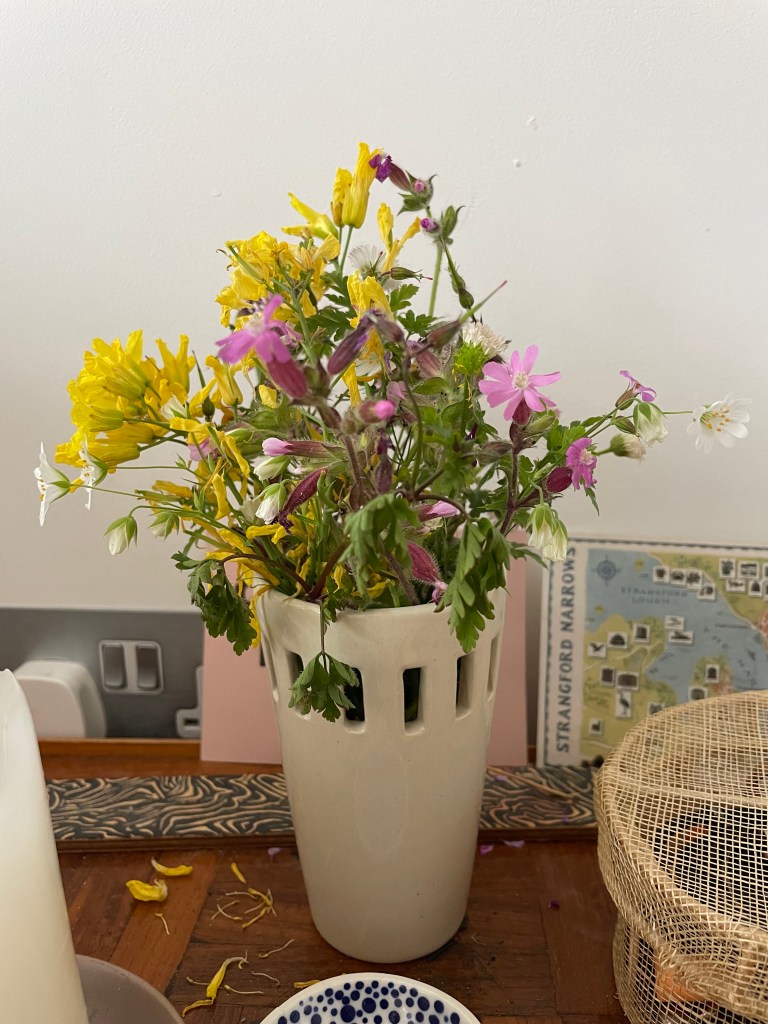
    On my way there I’d still not decided what to bring as my offering to the Women’s Circle that evening, to represent love and beauty. I’d considered my purfume, cheek tint and a card from a friend, in the rush of getting ready. But it struck me on the way there, that it was right next to me the whole time. It was the hedge. The one I pass on my way to work, to various community groups, to the beach and on my way currently to this circle. They show the seasons. They’ve let me change. They provide themselves again and again. I stopped the car at the next passing point and cut some of the bracken and picked some of the flowers. I realised they were not as soft and delicate as they seemed from the drivers seat. I recieved some scabs on my wrists and stings on my arm during the process. They reminded me in that moment that love and beauty often comes with pain and scars and stinging, as much as they do with vibrance and excitement and journeys. It is real love when the travellers passing through can endure both the beautiful and the difficult.

    That night was the first time in maybe a year that I felt beautiful. I was wearing a long black dress that I took up the hem of and left my sewing machine and box strewn across the kitchen table. I wondered again if the fabric was near the iron. I felt glad to have turned around and be going back. I’m glad to have made the choice to enjoy my time there not thinking about a potential fire here. My friend who runs it also needs pens and also needs me to enjoy myself tonight. I took a photo of myself in the mirror, maybe a remind to myself. Maybe as a reminder to people that I can be more than functional and useful and needed. I felt beautiful that night, not because a man has told me so or in the hope that he would. But because I chose to, because of the power of women and because I am seeing myself.

    The iron was on and I turned it off. I collected a handful of colouring pens. On arrival to the circle, 30 minutes late, it turned out I was the only one who had remembered. My friend had tried to contact me, but I was driving. So she said it was up to me if I wanted to stay, it was more of a line than a round this evening but as we enveloped eachother and I decided I wanted to be present, even if it was just for two points meeting. We chatted, shared stories and expressed our challenges in holding our boundaries. It is interesting what we have forgotten to remember.

    Not the flowers in question, picked by Pūlama on Sunday 18th May

  • Speaking to my phone

    The sea, it puts out the burning and leaves with it a sting that soothes. I wondered, as I watched the man swim around the cove if I ever, could leave this place. His small head, a fixed point drawing around the rock. There was a stretch, where I was worried, so I stayed. I have never spoken like this into my phone. It does feel easier. I hope to do this all again. I wish I could record the voices of the birds that are singing. But I guess you cannot translate this. With the water as it embraces the stone. They have all been here so much longer than us and we have so much to learn. We think we need to teach it, to bend it, but it is us that now must ache. 

  • The matter of spelling mistakes

    Upon review of my first post, I noted some spelling mistakes (along with some people who I had let know of this rambling record).

    I have always struggled with spelling. I can see myself now from a birdseye view sitting outside my Year 2 classroom, panicking politely with the commencement of that week’s spelling test. It was not until my second year of university, around 14 years later, that I was told to have passed with the flying colours… my Diagnostic Assessment for Dyslexia.

    The label brought with it relief but also a sinking feeling that some negative ideas I had of myself were true. I was in fact forgetful, ditsy and a little bit stupid. Confusing Dyslexia with low-intellect, I can turn back now and see how my confidence slipped. But also acknowledge that this diagnosis coincided with a reduction in alcohol consumption. During this sobering passage of time, I came in closer proximity with myself and it started to matter who I was, how I communicated and what I could remember. 

    I now no longer feel the weight of this facet so heavily. It does not slump across my shoulders, as it once did. It has the capacity at times to lift me up, encourage my hands and help me to think in novel ways. I realise now, that my leaving of certain situations and feeling lesser is more so a reflection of my company, than my own mind. I cannot recall passages from an article I skimmed in the morning’s news or hold my own in a jargon-heavy political debate. I know I would need to make detailed notes in the margin, with coloured illustrations to give myself a chance, but i also know I would not find joy in this exhange. I enjoy speaking to people about their own experience and hearing their stories. I like to make things with people, share skills and experiences. I like to use the library, attend talks, or listen to the radio (always with at least two notebooks to hand) when in need of understanding dense and complex subject matter, which of course can be dusted into conversation, if and when appropriate. 

    I attempt to finish a book a month. This labour usually results in the book growing. Becoming sandwiched with sticky notes and paper until the end. I understand that AI has beat me to it and read all reading material available. It is completing student assignments and ridding us of many professions. I worry, as I often do, what is being sacrificed in our pursuit of economising and optimising our relationship with the environment, along with how we record and communicate our experience of it. In permaculture they talk of how we can make our working relationship with the land more efficient, so that as Bill Mollison says, we can use our spare time ‘to sit on our veranda and play the guitar’. But we should not be able to spend all our time on the veranda, playing the guitar! 

    With the increase in use of AI, it feels marginally radical to leave in a sprinkling of spelling mistakes. A reminder of humanity, craft and learning from mishaps. I also like the unconscious bias that sometimes springs up when I look back at them. Although… I did receive my second parking ticket last month, as a result of me incorrectly spelling my number plate. “How was I to know that it was an ‘O’ and not a ‘0’?” I scoffed over lunch to some friends. My friend Henry kindly pointed out that, “The last three digits in number plates are always letters”, confusing wording of the explanation I know, but I was thankful for the knowledge and agreed that this mistake is worth correcting. 

    They have created an industrial level weeder now that uses AI. I think it uses drones, with a scan and burn strategy. I have only just learnt how to plant out on an industrial scale, so I am yet to jump enthusiastically onto this automated waggon. From my little experience, I can see there being great value in scanning your land with your eyes and hand weeding in a team. The benefits this would have in familiarising yourself with your land, along with providing work and connection to your local community.

    After initial weeding was done to my first post, I did return a couple. After all, if you ask five gardeners for their opinion, you will get 10 different answers. Apparently, forget-me-nots are considered a weed by some, as my favourite wild flower – this is not something I’ll be remembering to pluck out. Their Latin name is Myosotis alpestris, something I will also no doubt forget. From where I sit there is a quiet arrogance and exclusivity that comes with the use of Latin names by plant folk. Many of which originate from the first written records in Greece, as far back as 300 BC, by the wealthy clergy and scholars, as the peasant majority were completely illiterate. Those with the plants in their hands, were also most likely those without the pens (or a more appropriate ancient writing implement). So, with another rebellious swing, I would like to learn and use all the common names first. I think more than anything we need to invite people into the conversation of growing and connecting with nature, so first and foremost we need a common language to do so. 

    I recently started reading a pamphlet my Grandad put together on our family history, called The Cowslip Meadow. This flower is part of the primrose family, the other common names include: fairy cups, palsywort and plumrocks. He talks about how in the early stages he did not stray away from the current spelling of our surname in his research, but quickly learnt “it is good to remember that a vast number of our ancestors were illiterate and did not know how their surnames were or should be spelt”.  Despite this they still existed and felt the weight of living. He goes on to say that “a great deal of our heritage has just disappeared over the last hundred years and just doesn’t exist, so this is why it is so important to record everything we do and have now”. He wrote this in 2000, dedicated to his granddaughters, with the hope we would carry on where he left off. He is sadly no longer with us, and I wonder if he would marvel at how much we are able to record now but also how much easier it is to exist less in the world, as a result. I hope to preserve the relationships within our family primarily in the physical sense, and then in written record secondarily.

    My difficulty with spelling is part of my identity (maybe even my heritage), and I do not feel this is something I need to correct but instead understand and work with. In the same way that we must continue to hold a conversation with the land, those around us, what was before us and what may lay ahead. 

  • Say hello and wave goodbye…

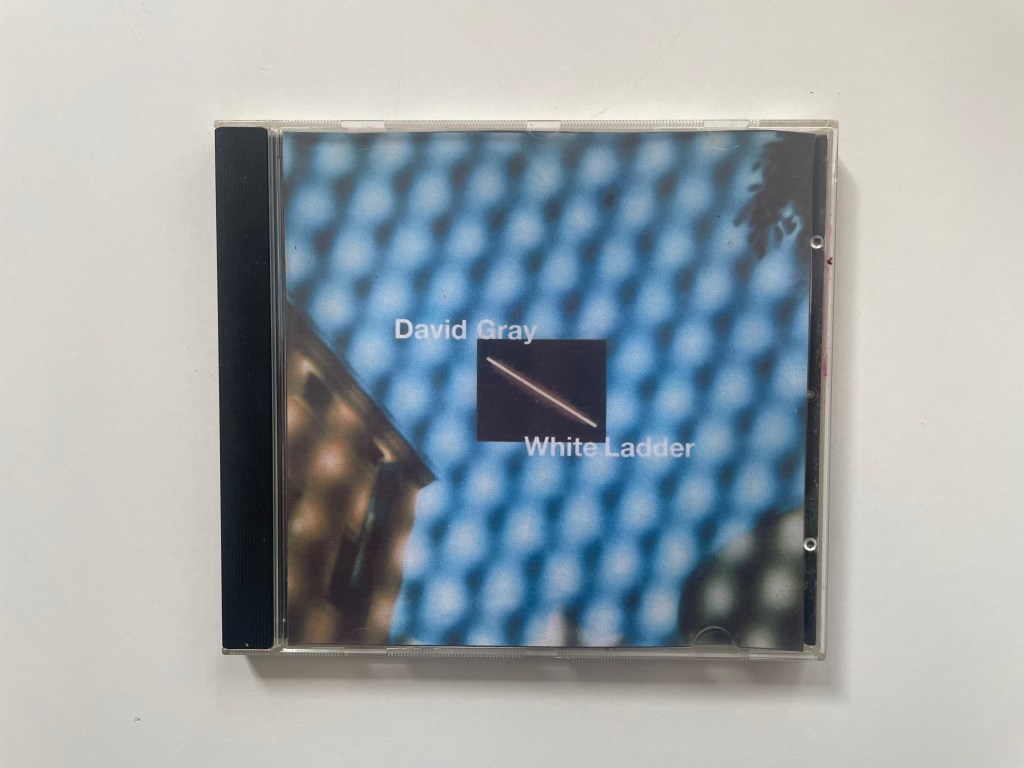
    Is the outro of David Grays album White Ladder, released on 27th November 1998. I was born 6 days later and the album rung out through my childhood, and summers spent on the South West coast. I decided to return to Devon and take it for all it’s seasons in January of this year.

    A hobby that ripened in the early days of my arrival, and has since somewhat subsided, was making rounds of local charity shops. Given the seasonal second-home nature of the town I now live, January provided slim pickings (but I was persistent). In contrast to that of East London, I noted a sluggishness to the stock rotation and a drastic increase in the Per Una to non-Per Una ratio.

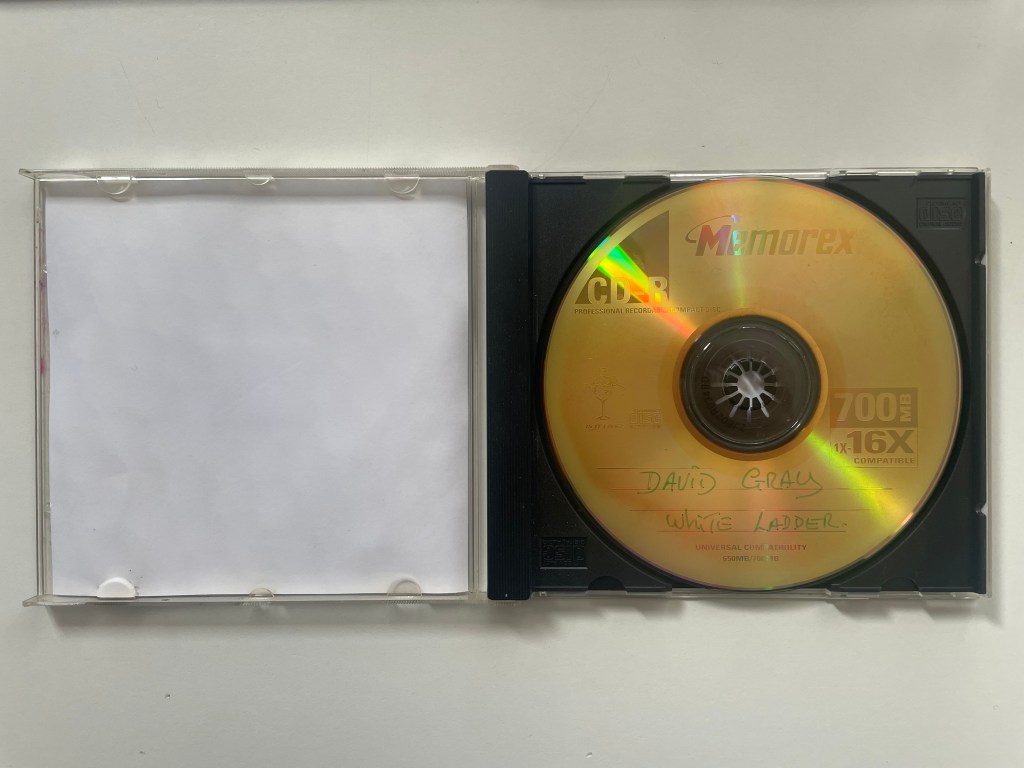
    Following a recent knee jerk deletion of Spotify and need for a car in this neck of the woods – reflective noise discs have gratefully rolled into my life. I have found solace in the CD section of charity shops, along with joy in my raspy throat as I drive home and movement in my feet as they explore new corners of a track and the kitchen. I have dicerned the best second-hand stores for CD’s, to be those in aid of animals – especially and funnily donkeys. They tend to reside in unassuming locations and are less savvy on price (CD’s that is). It is from said archetype that I salvaged a ripped copy of White Ladder, sandwiched repugnantly between Take That and Celine Dion.

    For the price of 50p, the way the cover art had been printed out and cut wonkily, along with similarly-crafted CD spine and track list – there was no doubt in my mind that I would be leaving without this plastic box of goodness. But with a £2 minimum spend and a now honed frugal approach to charity shopping, I appologetically tucked him back behind Celine and moved at an appropriate pace to the nearest cash machine.

    David Gray produced this album in his Stoke Newington bedroom, a stones throw from my prior home for almost 3 years. You can especially hear the DIY nature of his production in the track Babylon, where there is the audible sound of a car driving past. David talks of the imagry in this album being what my life was like – a young person in London, going out all the time and getting a little bit lost”. He talks of how the album was “speaking to myself. I was in my late 20s, had lost my youthful momentum and was looking at myself.”.

    This album has been fleshed out to me with the the experience of early-adulthood. Having grown up with it’s folky clubby simmerings in the backdrop, it holds a voice likened to that of an older family member, that I have now reached the age to hold conversation with. These layers of shared experience call to me and I have been climbing the lengths of this album for the past week – I am yet unable to bore.

    The final track, the title of this post, is 9 minutes long. Leaving you with the longing calls to delay an inevitable end, with fading whisps of “We were born before the wind. Who were we to understand?”. A friend who I recently said goodbye to, texted me after to say “I feel like my goodbyes are always a bit climatic for the experiences we share”. My dyslexic brain read this as ‘anti-climatic‘ instead of ‘climatic‘ and was mildly confused. Our affectionate farewells always felt like a solacing gossamer to me. Now reading back I understand and wonder what elements they felt we were weathering.

    With any uprooting and untethering, like a seedling we experience some level of transplant shock and require a short dormancy period before we can re-establish ourselves in new ground. But I think my probation is almost over and I am excited to start my tenure here.

    I have found anchorage in the writings of Patrick Laurie, a renaissance with brit-pop, on phone calls to loved ones and the seeking out new ones. I find comfort in conversations overheard or engaged with over shop countertops or across pavements. Feeling proud of the markings on my hands and the new ways I am learning to use them. Old friends and family are due to visit in the weeks ahead, as the weather warms. I intend to consolidate my abundant stock before I wave in the next new thing.